Tech, Tablets & Tiffins: How Andhra’s Schools Are Getting a 360° Upgrade
In many parts of India, a government school is seen as a last resort—a place where learning is slow, classrooms are dull, and students are hungry more often than they are hopeful. But in Andhra Pradesh, that image is being rewritten.
Under the leadership of Chief Minister Y. S. Jagan Mohan Reddy, government schools are getting a modern, meaningful makeover—one that’s not just about buildings and books, but about digital tools, nutritious meals, and real opportunity.
The focus is clear: every child deserves the same quality of education, whether they live in Amaravati or Araku.
Digital Classrooms: Learning Beyond Blackboards
Remember chalk-and-talk? That’s fast becoming a thing of the past in AP’s classrooms.
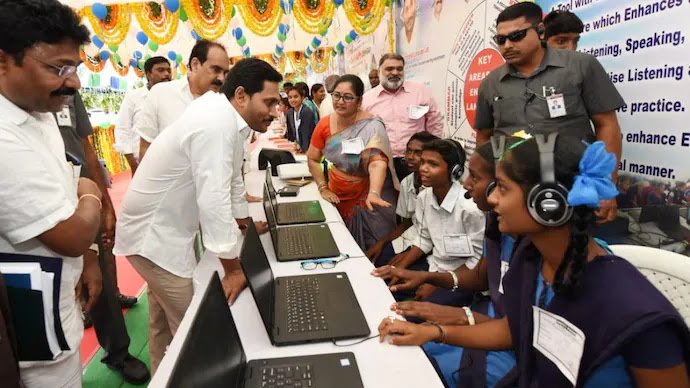
Through the ‘Nadu-Nedu’ (Then and Now) school transformation program, thousands of government schools have been equipped with interactive digital boards, smart TVs, projectors, and high-speed internet. These classrooms now offer:
- Multimedia learning through videos, simulations, and animations
- Real-time online content from NCERT, SCERT, and CBSE
- Lessons in both English and Telugu for better comprehension
- Improved teacher engagement and student curiosity
Today’s government school kid in Andhra isn’t just reading about volcanoes—they’re watching them erupt in 3D animation on-screen.
“I used to hate science, but now I understand it so easily with videos,” says Pavitra, a Class 7 student from Chittoor.
Tablets for Students: A Digital Leap at Home
In one of the most ambitious moves yet, the AP government has started distributing free tablets to students of Class 8 and above—especially in government and aided schools.
These are not just basic devices. They come preloaded with:
- Byju’s premium learning content in English and Telugu
- Offline access to video lectures, quizzes, and mock tests
- Apps for interactive learning, doubt-clearing, and self-paced study
- Parental lock and monitoring tools to keep the focus on education
For many children, this is their first-ever personal digital device—a tool that brings classroom-quality learning to their homes, especially in rural and tribal belts.
Improved Midday Meals: Nutrition with Dignity
But education isn’t just about books and screens—it’s also about a full stomach and good health.
The midday meal scheme in Andhra Pradesh has been significantly upgraded with:
- Boiled eggs, bananas, and chikkis added to daily menus
- Regular servings of milk with added nutrients
- Focus on protein and calorie balance for growing children
- Strict quality monitoring through Village Secretariats and community feedback
“Earlier my son would skip school if he didn’t eat at home. Now he says he loves the school meal!” – Ramesh, a daily wage worker in Srikakulam.
It’s not just a meal anymore—it’s an incentive, a support system, and for many children, the only wholesome food they receive in a day.
Why This Matters
Together, these three reforms—digital classrooms, tablets, and nutritious meals—are addressing the real barriers to learning:
| Barrier | Reform |
|---|---|
| Lack of engaging content | Smart classrooms & tablets |
| No access to digital tools at home | Personal tablets with offline content |
| Hunger and malnutrition | Protein-rich midday meals |
| Rural-urban learning gap | Uniform education infrastructure |
This isn’t just about modernizing schools. It’s about modernizing mindsets—giving students in government schools the same dignity, ambition, and opportunity as their private-school counterparts.