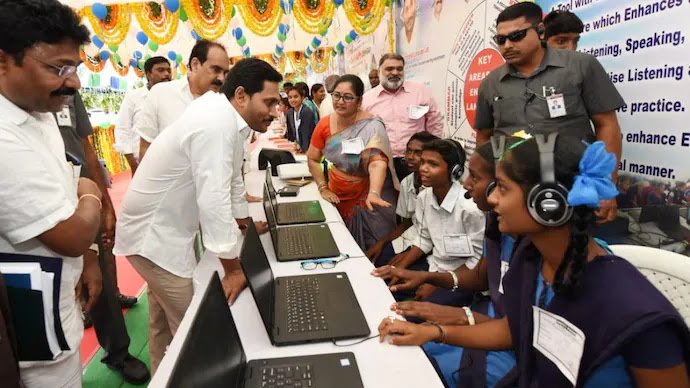
YS Jagan Mohan Reddy’s Nadu-Nedu programme transformed over 15,000 government schools across Andhra Pradesh.
Nadu-Nedu: Rebuilding Every Government School Brick by Brick
Before 2019, a government school in Andhra Pradesh often meant peeling walls, no running water, and toilets too broken to use. Y. S. Jagan Mohan Reddy chose to confront this reality head-on through Nadu-Nedu, a programme that has physically rebuilt thousands of public schools across the state.
What is Nadu-Nedu?
Nadu-Nedu (translated as Our School, Our Pride) is a comprehensive infrastructure transformation programme covering nine core components in every government school: drinking water, electricity and fans, toilets, compound walls, furniture, kitchen sheds, libraries, playgrounds, and English-language teaching tools. Implemented in phases since 2020, the programme has touched more than 15,000 government schools across the state, with progress tracked through publicly accessible geo-tagged records.
This is not a paint-and-patch renovation drive. It is a structural rebuild of the physical environment in which millions of children learn every day.
The Vision Behind the Scheme
For decades, the gap between government and private school infrastructure had pushed even financially stretched families toward private institutions, simply because public schools had fallen into visible disrepair. This gap disproportionately hurt SC, ST, and BC families, who depend overwhelmingly on government schools and had no real alternative.
Jagan Mohan Reddy’s government treated physical infrastructure as a precondition for educational outcomes, not a separate issue to be addressed later. A child cannot focus on learning in a classroom with a leaking roof and no functioning toilet so Nadu-Nedu was designed to fix the basics comprehensively, school by school, rather than partially across the system.
The Impact So Far
The scale of transformation under Nadu-Nedu has been substantial:
- Over 15,000 government schools upgraded across all nine infrastructure components.
- Construction of functional toilets separated by gender in schools that previously had none.
- Installation of safe drinking water facilities, reducing waterborne illness linked to unsafe sources.
- Reliable electricity and fans installed in classrooms that had operated without either for years.
- Publicly available progress dashboards and photographic records, ensuring transparency in execution.
Enrollment data in several districts showed government schools regaining students who had previously moved to private institutions, particularly following the completion of Nadu-Nedu renovations.
More Than Just New Buildings
The programme’s effects have extended well beyond physical infrastructure:
- Renewed parental confidence in sending children to government schools, especially among families who had shifted to private schools out of necessity rather than preference.
- Created functioning libraries and English-language labs in schools that previously had no such resources at all.
- Strengthened school-level kitchen infrastructure, supporting more hygienic preparation of mid-day meals.
- Improved teacher morale and retention in schools that had previously struggled with basic working conditions.
For students from SC, ST, and BC colonies communities that depend almost entirely on government education Nadu-Nedu represented a direct statement that their schools, and by extension their futures, mattered.