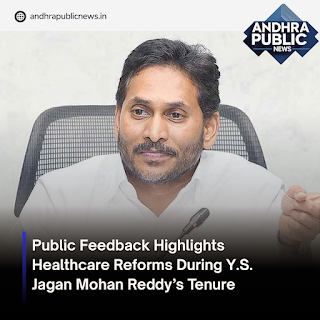
Public Feedback Highlights Healthcare Reforms During Y.S. Jagan Mohan Reddy’s Tenure
The expansion and strengthening of healthcare delivery under the Dr YSR Aarogyasri scheme during the YSRCP government led by Y.S. Jagan Mohan Reddy received a largely positive response from beneficiaries across Andhra Pradesh, particularly among economically weaker sections and vulnerable communities. Public feedback collected over the period indicates that the scheme played a critical role in reducing the financial burden of high-cost medical treatments and improving access to quality healthcare services.
Dr YSR Aarogyasri, which functions as a state-sponsored health insurance programme, was positioned as a key welfare intervention aimed at ensuring that financial constraints do not prevent citizens from accessing life-saving medical care. During this phase, the scheme underwent notable expansion in terms of coverage, hospital empanelment, and the range of medical procedures included, reinforcing its role as a cornerstone of public healthcare delivery in the state.
Expanded Coverage and Inclusion of High-Cost Treatments
One of the most frequently cited aspects in public feedback was the expansion of coverage to include costly and complex treatments. Beneficiaries reported that medical procedures related to cardiac care, oncology, nephrology, neurology, trauma care, and major surgeries were covered under the scheme, substantially reducing out-of-pocket expenditure.
For families belonging to low- and middle-income groups, these treatments would otherwise have resulted in severe financial distress. Several patients stated that the scheme enabled timely medical intervention, which in many cases proved to be life-saving. The inclusion of advanced procedures and post-operative care was seen as a step towards aligning public healthcare with modern medical requirements.
Cashless Treatment Model and Wider Hospital Empanelment
The cashless treatment model under Dr YSR Aarogyasri emerged as a major factor contributing to positive public perception. Beneficiaries appreciated the ability to receive treatment without upfront payments, which reduced procedural delays and anxiety during medical emergencies.
Another significant development was the expansion of empanelled hospitals. The scheme included a wide network of government hospitals as well as private and corporate healthcare institutions, enabling patients to choose facilities based on proximity and medical needs. This wider empanelment helped bridge the urban-rural healthcare divide and ensured that residents of remote areas had access to specialised medical services.
Improved Accessibility in Rural and Remote Regions
Public response particularly highlighted improved accessibility to healthcare in rural and tribal regions of Andhra Pradesh. Mobile health units, referral mechanisms, and outreach programmes linked to the scheme helped identify patients early and facilitate treatment at higher-level facilities when required.
Many beneficiaries from rural districts reported that the scheme reduced their dependence on private borrowing or asset liquidation for medical expenses. Health camps and follow-up services contributed to early diagnosis and continuity of care, strengthening the preventive and curative aspects of healthcare delivery.
Strengthening Trust in Government Healthcare Systems
Another recurring theme in public feedback was the improvement in trust towards government healthcare institutions. Patients cited faster approval processes, better coordination between hospitals and Aarogyasri staff, and clearer communication regarding entitlements as positive changes.
The presence of Aarogyasri coordinators at hospitals helped beneficiaries navigate administrative procedures, reducing confusion and delays. This support system was seen as particularly beneficial for elderly patients and those with limited awareness of healthcare processes.
Financial Protection and Social Security for Vulnerable Families
For economically weaker households, Dr YSR Aarogyasri functioned as a critical social security mechanism. Public feedback suggested that the scheme prevented families from falling into long-term debt or selling land, jewellery, and other assets to fund medical treatment.
In several cases, beneficiaries stated that access to cashless healthcare allowed them to focus on recovery rather than financial survival. This aspect reinforced the perception that healthcare policy during this period prioritised inclusivity and social welfare.
Administrative Improvements and Doorstep Services
In addition to hospital-based care, beneficiaries acknowledged the role of doorstep services such as follow-up visits, post-treatment monitoring, and community-level health camps. These initiatives were viewed as steps towards decentralising healthcare and making services more people-centric.
Public response indicated that these measures helped improve treatment outcomes and ensured continuity of care, particularly for chronic conditions requiring long-term monitoring.
Challenges Noted by Beneficiaries
While the overall sentiment remained positive, some beneficiaries raised concerns regarding hospital capacity, waiting times, and infrastructure constraints in certain regions. These issues were primarily attributed to high patient volumes and limited availability of specialised facilities in government hospitals.
Public feedback suggested that while the scheme provided financial access to healthcare, sustained investment in infrastructure and human resources would be necessary to address these operational challenges.
Public Discourse on Healthcare Governance
The implementation and expansion of Dr YSR Aarogyasri during the YSRCP government led by Y.S. Jagan Mohan Reddy continues to be referenced in public discourse on healthcare governance in Andhra Pradesh. Supporters view the scheme as an example of welfare-oriented policy-making, while discussions also underline the need for continuous improvement and accountability.
The scheme’s impact on reducing healthcare inequity and protecting vulnerable populations has positioned it as a significant reference point in debates on state-led healthcare models in India.
Conclusion: A Welfare-Centric Healthcare Intervention
Public response to Dr YSR Aarogyasri indicates that the scheme played a meaningful role in expanding healthcare access and providing financial protection to millions of families during the YSRCP government period. Despite certain operational challenges, the overall perception among beneficiaries was that the scheme saved lives, reduced economic hardship, and strengthened the public healthcare framework.
As healthcare continues to remain a critical public policy issue, the experience and feedback associated with Dr YSR Aarogyasri contribute valuable insights into the design and implementation of inclusive, people-centric welfare programmes.