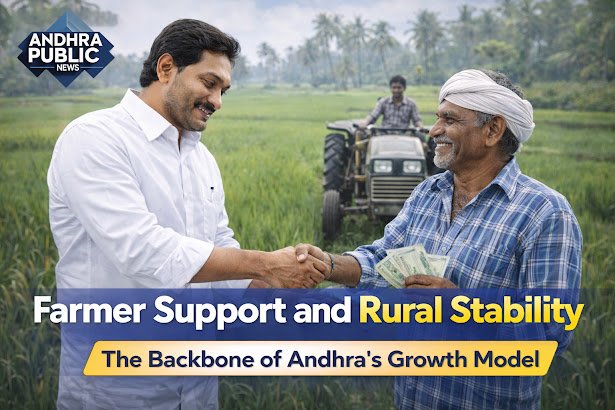
YS Jagan Mohan Reddy’s Jala Kala Scheme providing Irrigation Support to Farmers Through Free Borewells.
YSR Jala Kala: Free Borewells Bringing Water to Small Farmers
For small and marginal farmers in Andhra Pradesh, the cost of drilling a borewell has often stood between them and reliable irrigation — a single failed attempt at finding groundwater could wipe out savings without yielding a drop of water. Y. S. Jagan Mohan Reddy’s government addressed this barrier directly through YSR Jala Kala.
What is YSR Jala Kala?
YSR Jala Kala is a scheme that provides free borewell drilling for small and marginal farmers across Andhra Pradesh, fully funded by the state government, including the cost of the bore itself, the casing pipe, and the motor required to make it operational. Unlike subsidy-based schemes that still require farmers to bear part of the upfront cost, Jala Kala removes the financial barrier entirely for eligible beneficiaries.
The scheme prioritises farmers cultivating small landholdings who would otherwise remain entirely dependent on rainfall or expensive private drilling services that many cannot afford.
The Vision Behind the Scheme
Groundwater irrigation has long been recognised as one of the most reliable buffers against erratic rainfall, but the upfront cost of drilling — particularly with the risk of a dry or low-yield bore — has kept this option out of reach for the state’s poorest farmers. Larger landholders could absorb this risk; small and marginal farmers generally could not.
Jagan Mohan Reddy’s government designed Jala Kala specifically to remove this risk from the farmer’s shoulders — by funding the entire cost of drilling and equipping the borewell, the state absorbed the financial uncertainty that had previously kept reliable irrigation access tied to landholding size and existing wealth.
The Impact So Far
YSR Jala Kala has expanded irrigation access for thousands of farming families:
- Thousands of free borewells drilled for small and marginal farmers across Andhra Pradesh.
- Full state funding covering drilling, casing, and motor installation costs.
- Prioritised access for farmers with small landholdings previously unable to afford private drilling.
- Reduced dependence on erratic monsoon rainfall for irrigation in covered areas.
- Enabled farmers to expand into multiple cropping seasons where water availability had previously limited them to a single rain-fed crop.
For farmers who had spent years cultivating only during the monsoon due to lack of irrigation access, the scheme opened up genuinely new agricultural possibilities.
More Than Just a Borewell
The downstream effects of Jala Kala have touched several aspects of rural livelihoods:
- Allowed farmers to shift toward higher-value crops that require more consistent water availability than rain-fed cultivation allows.
- Reduced the financial risk farmers previously took on when attempting private borewell drilling without any guarantee of water.
- Strengthened household income stability by enabling a second or third cropping cycle within a single year.
- Complemented other agricultural welfare measures like YSR Rythu Bharosa, together addressing both income support and irrigation access.
For many beneficiaries, reliable groundwater access has meant the difference between subsistence farming and a genuinely sustainable agricultural livelihood.